 question about
a replaced Fuel Pump still being loud...
question about
a replaced Fuel Pump still being loud...
D-Jet Comparing Early vs Late Fuel Delivery,
including Consideration of the Early
Production (Three-Port) vs. Late Production (Two-Port) Fuel Pumps
Mar 2026 R Kwas [Comments Added]
-----------------
Early Production Fuel
Supply Configuration
Three-Port Fuel Pump
Function of the Three-Port
Fuel Pump
Late Production Fuel
Supply Configuration
Two-Port Fuel Pump
Function of
the Two-Port Fuel Pump
Fuel Pressure Regulator
Notes on Troubleshooting and
Repairs
Abnormal Fuel
Delivery Conditions
Replacing a Fuel Pump
D-Jet
Fuel Pump Overpressure Relief Valve Functional Test
Rattling vs Cavitation Noises from a Fuel Pump in Distress
Full Bosch D-Jetronic SW-EM Techincal Article: https://www.sw-em.com/bosch_d-jetronic_injection.htm
Link to info on 1800E/ES Fuel Tank: https://www.sw-em.com/Fuel_Tank_Notes.htm#1800E_Tank
WHEN WORKING WITH FUEL IN THE OPEN: OBSERVE OPEN FUEL, SAFE OPERATING, AND FIRE PREVENTION PRACTICES AND PROCEDURES!
Remember that the Fuel delivery lines of the D-Jet system hold pressure for some time, even after Fuel Pump power has been removed, so when working on the fuel delivery system plumbing, be ready for and prepared to catch squirting fuel safely! WORK SAFELY!
Background:
Fuel Delivery in the D-Jet equipped cars underwent some evolution from the early configurations, to the later, even before the fuel gets to the engine compartment! Early Three-Port and later Two-Port Fuel-Pumps, and Fuel Filters can be interchanged with appropriate changes in plumbing, but variations can be confusing. Here is a collection of variations and other factors to consider.
------------------
My response to a
question about
a replaced Fuel Pump still being loud...
"A loud/rattling Fuel Pump is the symptom of its internal Bypass Valve working, because the circulating system is not circulating, and pump is "dead-headed" (pumping into a blockage). This can be caused by a Fuel Pressure Regulator failure, but also something as simple as a blocked Return Line to Tank (...as you should know, the D-Jet is a circulating fuel system).
I'd remove Return Line at FPReg, use another piece of line to route return into a catch bucket, and see if there is flow and noise stops (meaning FPReg is OK, but return is blocked).
OBSERVE SAFE OPEN/PRESSURIZED FUEL HANDLING PRECAUTIONS! See also:
https://www.sw-em.com/bosch_d-jetronic_injection.htm#Rattling_Noise_at_Fuel_Pump
Good Hunting!":[...but
the solution was not the classic one... The typical cause of a "loud or
"rattling" Fuel Pump on D-Jet cars is a failed Fuel Pressure Regulator or
blocked Return line to the Tank, but here, another issue was found to be the
cause...]
UPDATE: The owner fedback that the noisy FuPu was eliminated once the Fuel Filter was relocated to downstream of the Fuel Pump (it had been upstream, between FuPu and Tank). That suggests to me the noise was due to the FuFi** being on the sucking side, and I expect at least partially (if not substantially, or nearly totally!) blocked, causing the FuPu to cavitate, a process which can certainly be a noisy one. Once the FuFi was relocated to "behind" the FuPu (on the pressure side), it was no longer noisy...(BUT the FuPu is now subjected to the contamination from the Tank which clogged the FuFi in the first place, so this is a separate issue which needs addressing!
There is something to be learned/suspected from this: The Tank is probably internally rusted and shedding particles (as I have experienced firsthand!). ...if this situation and experience had occurred while I was troubleshooting, I would have also emptied the particulate contamination from the FuFi and examined it to see what it was...if rust particles (see: LINK) then the proper long-term fix, in addition to renewing the FuFi, would be to clean the Tank of that, and all other possible particulate contamination!).
** Note on Fuel Filter: The OE FuFi is high pressure capable, and it is quite large, so there is a huge filter medium surface area for keeping the pressure differential low as it (might) collect a bit of debris, unless of course, the filter is completely blocked by abundant amount of debris which has been caught, in which case the (reminder also the D-Jet is a continuous circulating fuel system).
Consideration and Comparison of the Early vs Late D-Jet Fuel Supply Systems:
The above finding and function of location of Fuel Filter has prompted a closer look at the Fuel Supply implementation. It seems that the D-Jet cars had some variations in Fuel Delivery configuration (from Early Production Three-Port to Late Production Two-Port). Also changed, was the location of the Fuel Filter and even Fuel Pressure Regulator...
Early Production Fuel Supply Configuration (Notable Differences to the Late Configuration: Pre-Pump Fuel Filter, Three Port Fuel Pump):
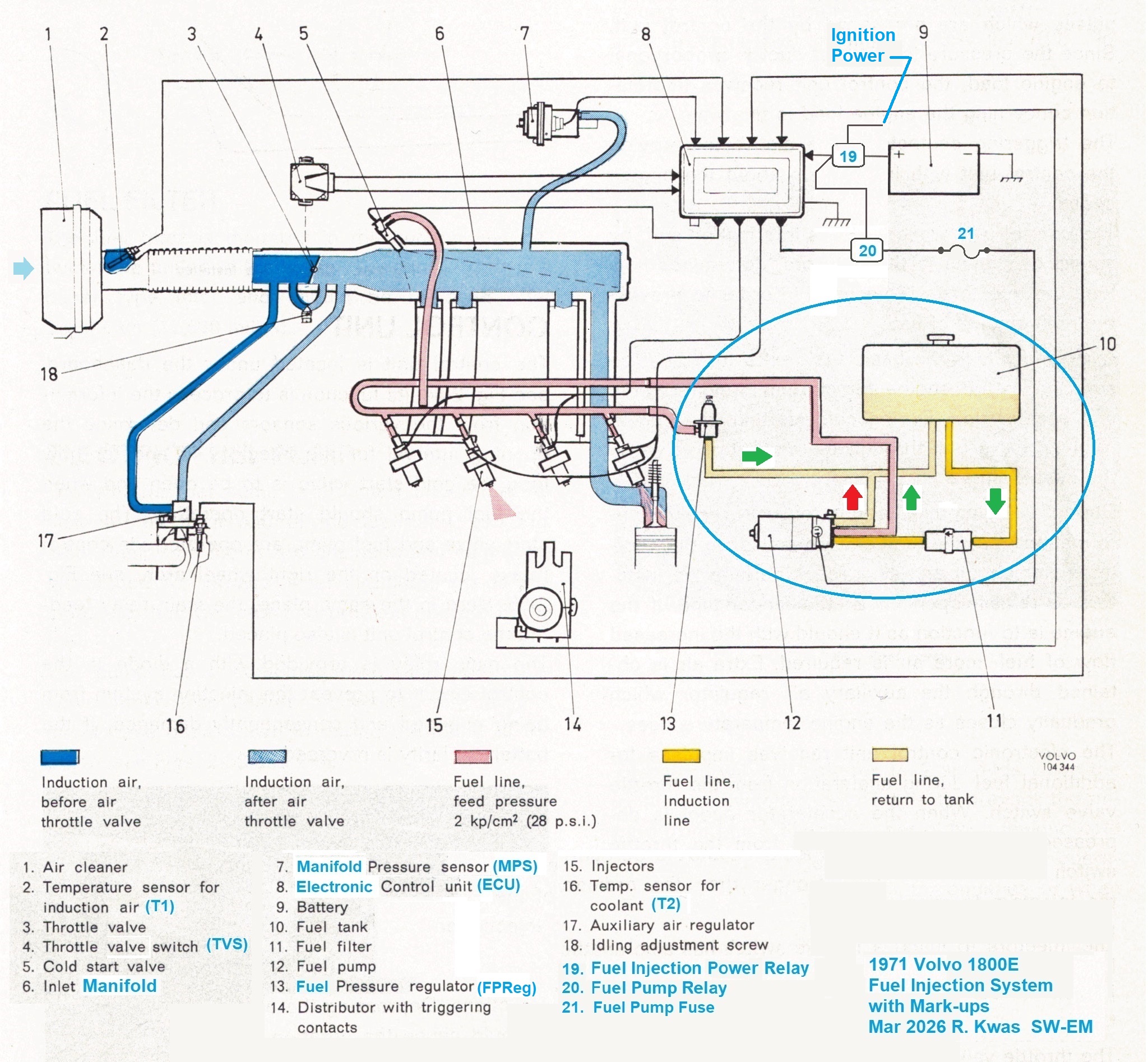
Early production Bosch D-Jet Fuel Delivery and Injection System, based on the
1971 1800E Factory Service Manual. In the
area of interest, note the Fuel Pump is a Three-Port
type, with a separate return path used under a
Fault Condition, sharing this with
normal fuel Return path from the FPReg,
which is a two-port type as it is located at the end of the Fuel Rail. The nomenclatures
are amended to be consistent with other published info and
discussions, also added are the Power and Fuel Pump Relays and Fuse, which were
not shown in the original Volvo documentation. Link to:
Fuel Pump Power
Three-Port Fuel Pump is a marvel of electro-mechanical engineering!
Early production Three-Port Fuel Pump info from the 1971 1800E factory manual. It can be seen that the flow from both FPReg and Fuel Pump Overflow/Pressure Relief Valve are by way of external plumbing.
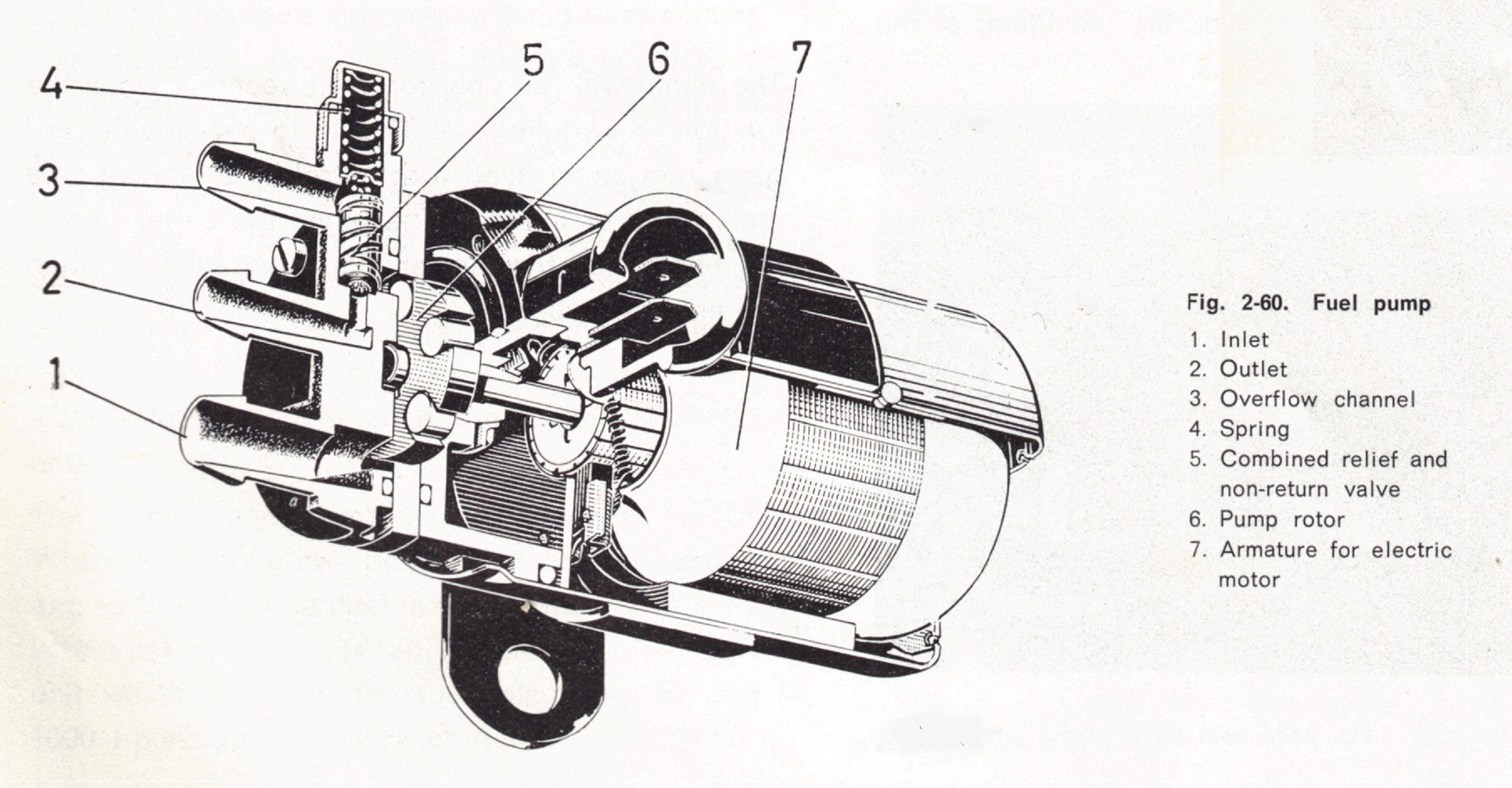
Source: 1971 1800E factory Service Manual. Bosch Three-Port
Fuel Pump with internal Relief / Non-Return Valve.
It not only pumps fuel normally, but it also accommodates some other operating conditions, the simplest (not a problem, but which can occur) when just running out of fuel [for men drivers!], then replenishing the supply... Once the Tank is refilled, and fuel is once again available to be pumped to the engine compartment, the internal combination Relief / Non-Return Valve helps to prime the Fuel Pump, and remove air, to allow starting and running normally.
Another Normal Condition which the Fuel Pump accommodates, is simply turning OFF the engine. The Relief / Non-Return Valve then serves to prevent flow back when the Pump itself has been powered down, to minimize subsequent Start times.
The final function of the Relief / Non-Return Valve is to accommodate a true Fault Condition which may occur. It comes into play, when the downstream system (Fuel Pressure Regulator or other) malfunctions and essentially blocks the flow. This condition is known as pumping into a "Dead-Head", and it can result in damage if there was not a provision to handle the sky-rocketing pressure safely. This is where the Relief / Non-Return Valve also serves to route the otherwise soaring pressure, (caused by the pump still continuing to pump fuel, but it not being able to move due to the blockage), to the Return Line, which also sends back fuel unused by the engine, to the Tank. Excessive fuel pressure, possibly resulting in damage in the system, is thus avoided.
Function of the Three-Port Fuel Pump:
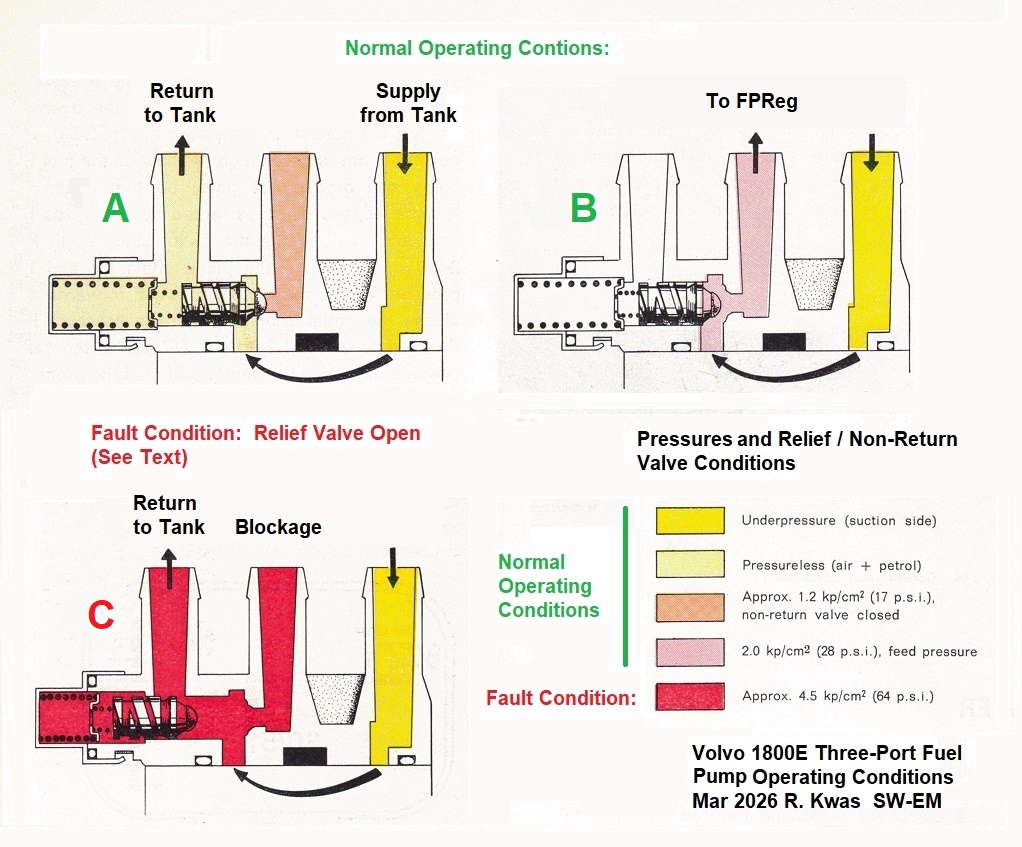
Operating Conditions for the Three-Port Fuel Pump. Based on the 1971 1800E
factory Service Manual with additions by the author. In
Normal Condition A, the left Port
is used to vent air in the pump rotor to the Tank to prime the Pump (flow is
combined with unused fuel coming from FPReg).
Condition B is the normal
operating condition when engine is running.
Condition C is a Fault Condition
caused by a downstream blockage of the system where the
Relief Valve opens to relieve the skyrocketing fuel pressure and return the
pumped fuel back to the Tank using the same Return path normally used to
return fuel not used by the engine.
Condition C is often accompanied by rattling or other noise as the Valve
cycles with pressure pulses from pump, and probably other engine running
abnormalities.
Late Production Fuel Supply Configuration (Notable Differences to the Early Configuration: Pre-filter Internal to Fuel Tank, Post Pump Fuel Filter, Two-Port Fuel Pump):
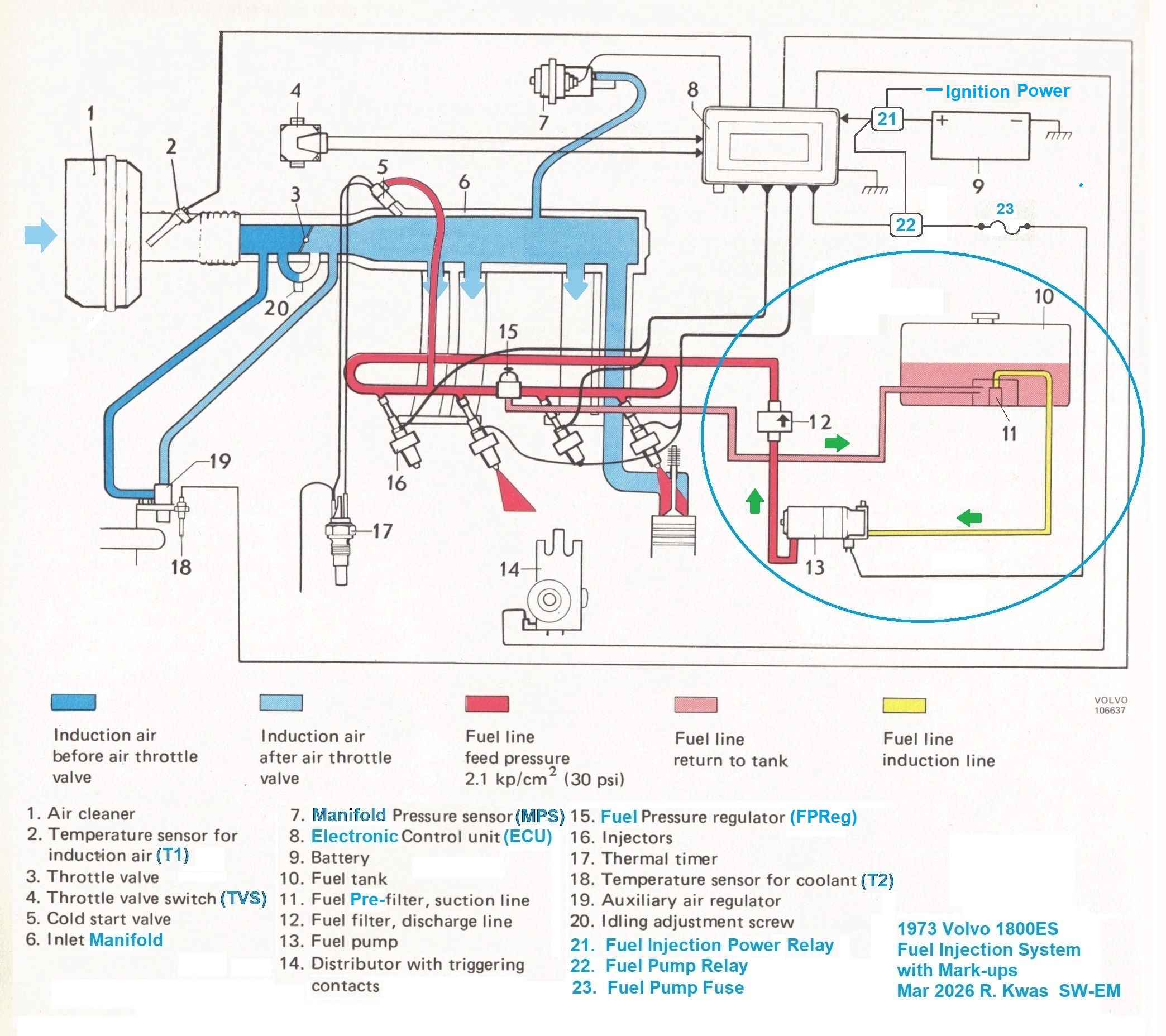
Late D-Jet, based on the 1973 1800ES Factory Service Manual. In the
Area of Interest, the Two Port
Fuel Pump and associated elements are evident.
Normal fuel flow is shown, and
flow under a Fault condition, with Overflow Valve open, is internal to Pump, see
below! Corrections, and
amendments to the nomenclatures to be consistent with other published info and
discussions are made, and again, also added are the Power and Fuel Pump Relays and Fuse, which
were not shown in the original Volvo documentation.
Note that the FPReg is a Three-Port type, and its position was changed to central on the Fuel Rail.
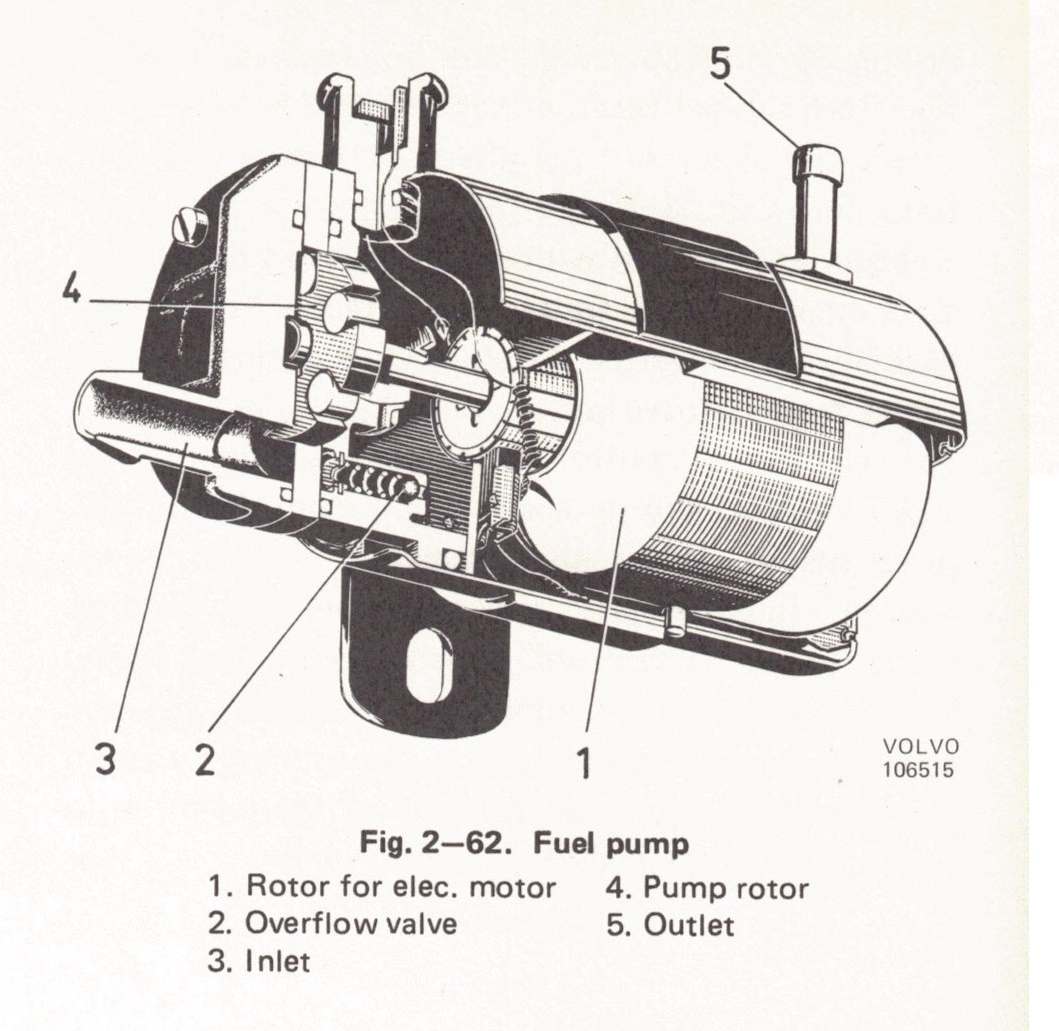
Two-Port Fuel Pump from the 1973 1800ES Factory Service Manual
...with Internal Bypass Valve flow routing, associated with
in-Tank Pre-filter and Post Pump Fuel Filter shown above!
Function of the Two-Port Fuel Pump:
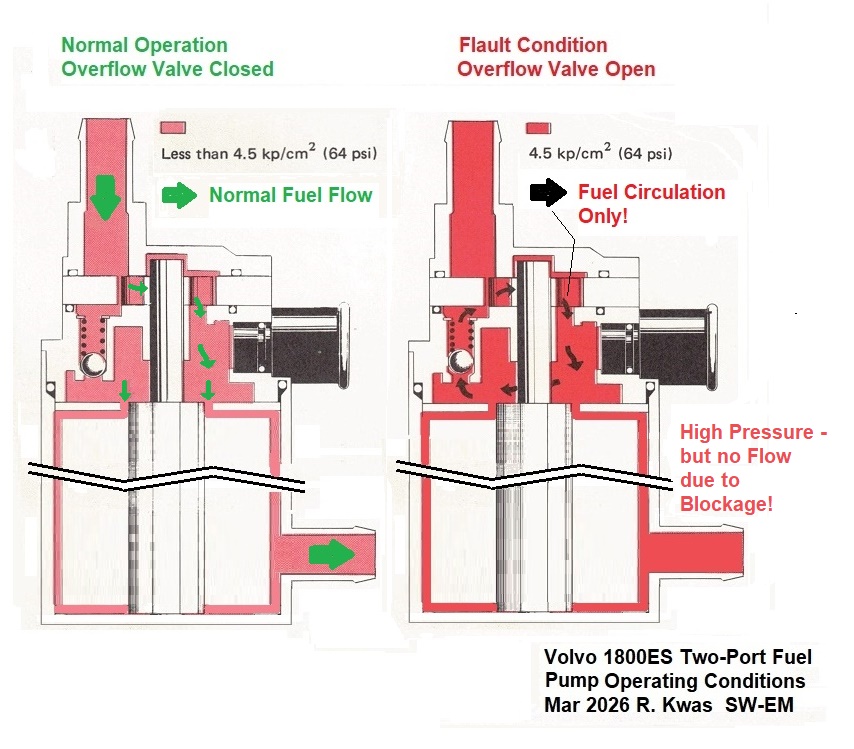
Late Production Two-Port (Wet Motor) Fuel Pump info based on diagram as shown in the 1973 1800ES Factory Service Manual. It can be seen here that the Overflow Valve flow occurs internally and does not flow by way of a third port, and external plumbing. The pressure sensing Overflow Valve is simply located between inflow and outflow of the pump in the housing, so that when a blockage situation occurs downstream, causing pressure to rise and exceed the Overflow Valve's 64PSI / 4.5kp/cm2 rating, it causes the Valve to open and the fuel then simply circulates inside the pump housing. Again, this will likely be accompanied by Fuel Pump Noises, unusual to the driver, and other engine running abnormalities, if the driver takes no notice of the noises...
FPReg is an adjustable, fully mechanical regulator. located on the Fuel Distribution Pipe (Fuel Rail). It controls the pressure in the Fuel Rail, which supplies Injectors, to 2.0kp/cm2 (28psi). By being supplied by the full Fuel Pump output volume, Pressure Regulator is able to keep pressure in the Fuel Rail constant under all levels of fuel demand from the engine and D-Jet Electronic Control Unit.
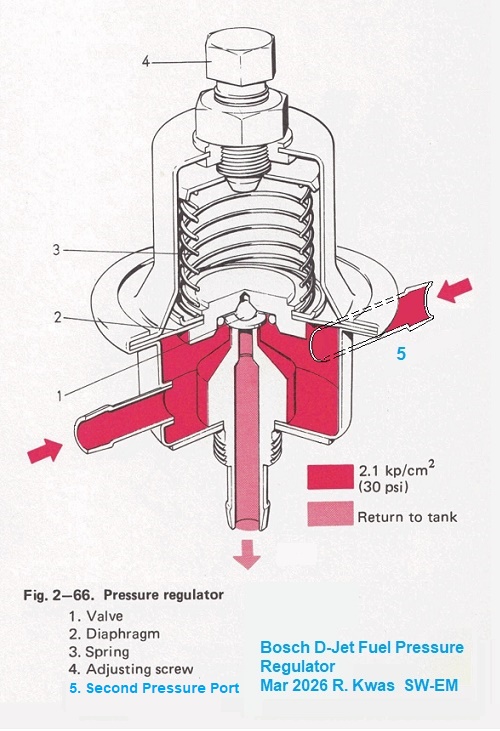
Fuel Pressure Regulator based on diagram as shown in the 1973 1800ES Factory
Service Manual. I have added the
Second Pressure Port to the
drawing which was not shown. The Second Pressure Port was added when the
FPReg was relocated from the early production firewall position, where it was
at the end of the Fuel
Rail, to the
later middle of Fuel Rail location. Both variations are shown
here:
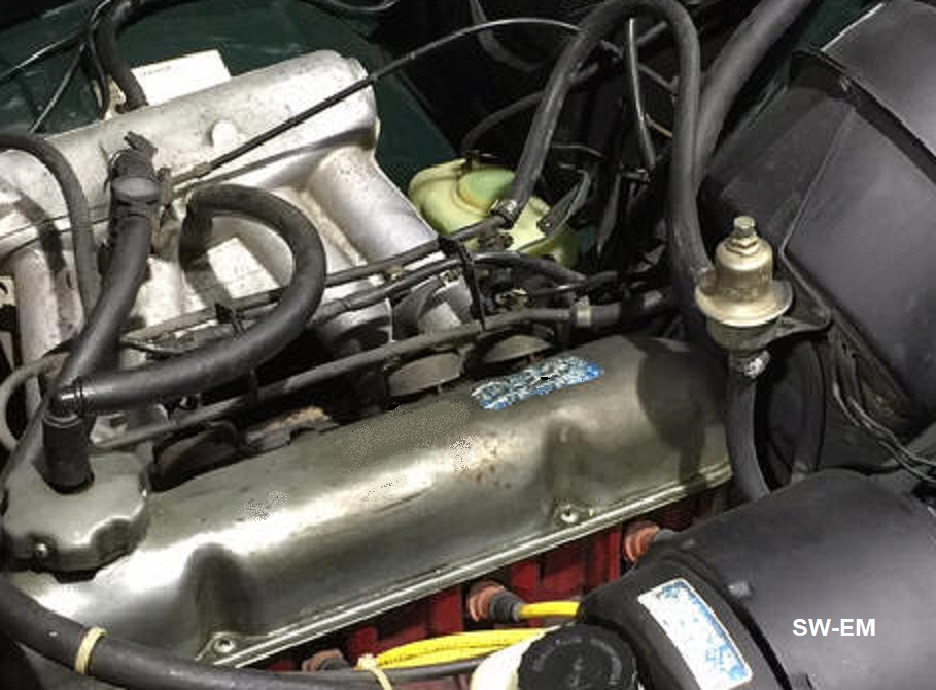 |
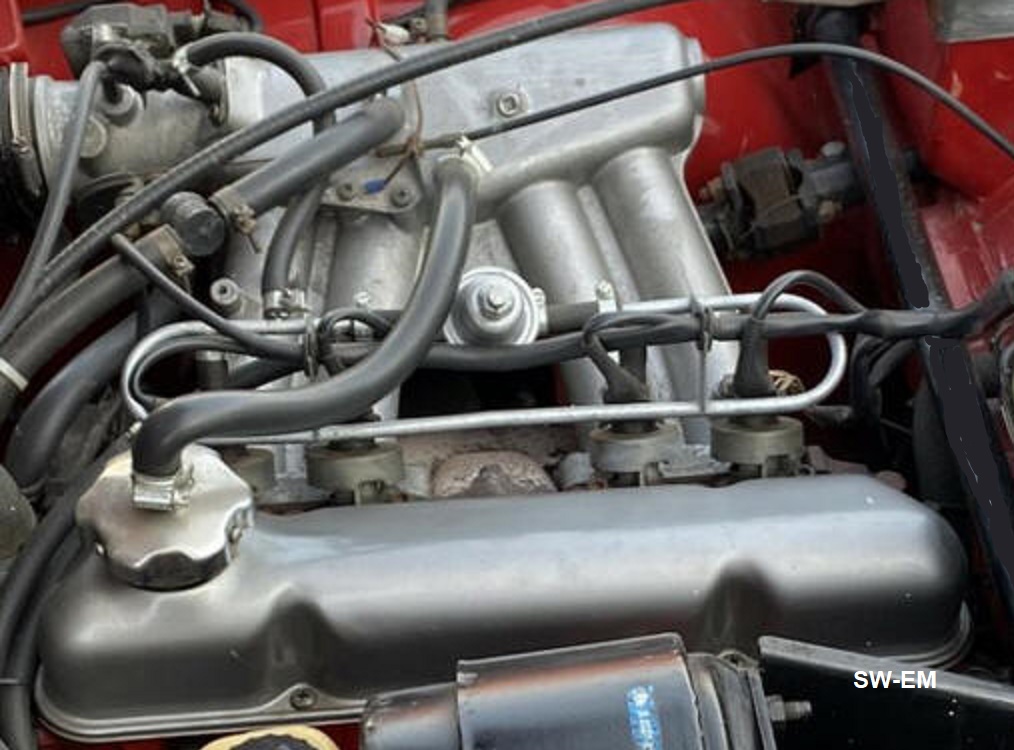 |
| Early two-port FPReg location, on a bracket at Heaterbox. | Late three-port FPReg located in the middle of Fuel Rail, over the engine, self-supported. |
My comments to an 1800List question: 1800list@groups.io | D Jet pressure regulator "...can the pressure regulator produce swings in fuel pressure that defy adjustment?"
"...that is not a failure mode I can see happening on this highly reliable component...either the diaphragm it is able to regulate pressure quickly to the setpoint (and you should see few variations from that pressure with a correctly functioning Fuel Delivery System! **), or the diaphragm is stuck (or something else is not right!), and pressure skyrockets until Over-Pressure Relief Valve in Fuel Pump opens and limits it to ~60PSI, with new noises the operator should take note of (if there are no other abnormal symptoms to clue them in that need to be checked out).
** The Relief Valve operating can typically be caused by a partial or intermittently occurring blockage in lines to FPReg or Return to Tank, or even post-pump Fuel Filter...a blockage before the Fuel Pump (like at the in-Tank Prefilter) will cause a pressure drop as it starves to Pump on the suction side..."
Notes on Troubleshooting and Repairs:
Abnormal Fuel Delivery Conditions:
A common issue is that the Fuel Pump is not electrically supplied power after the ECU times out, because it "decides" the engine is not running because it gets no pulses from the Distributor Contacts, so no longer enables the Fuel Pump Relay (LINK), OR that Fuel Pump is not being supplied elec power AT ALL (possibly caused by an open Fuse 5 [or associated connections], see same LINK!), OR also a common cause is a blocked downstream FuFi. If there is no Pre-Pump Filter, the Pump and Post Pump FuFi are subject to whatever particulate (rust particles) come along from the Tank...not so good.
In a blocked Pre-pump FuFi, filter prevents flow into the suction side of Fuel Pump, possibly resulting in cavitation noises, these are different noises from when the internal over-pressure Valve rattles as it relieves over-pressure...
Beware: There are also variations in the ports of the Injected Tanks! See also below. Link: 1800 Fuel Tank
Replacing a Fuel Pump: OBSERVE OPEN FUEL, SAFE OPERATING, AND FIRE PREVENTION PROCEDURES! Remember that the Fuel delivery lines of the D-Jet system hold pressure for some time, even after Fuel Pump power has been removed, so when working on the fuel delivery system plumbing, be ready for and prepared to catch squirting fuel safely! WORK SAFELY!
Both Two and Three-port Fuel Pumps are functionally interchangeable, with the appropriate changes to the plumbing as discussed above!
PLACEHOLDER FOR DETAILS I understand Datsun 260 Fuel Pumps are the equivalent of the NLA Volvo parts.

Early Fuel Tank (Version 2, no Prefilter) showing internal arrangement.
Suction line draws from the bottom of Anti-Slosh Compartment,
and departs from side of Tank, while Return line enters front of Tank
and is routed into bottom of ASC.
Note: When replacing Two-Port Fuel Pump with a Three-Port type, the location in the flow of the Fuel Filter must be considered (whether downstream or upstream of the FuPu), it may need to be changed...this is a decision of the installer, based of findings and cause of the failed Fuel Pump. If it is apparent from investigating what particulate debris has been captured in the Fuel Filter, that there are rust particles coming from the Tank (a situation which the author has experienced first hand), a pre-pump filter might be a good idea to keep this out of the replacement Fuel Pump! The Pre-filter (plastic screen in the later Tank, as seen here, may do the job if intact). To inspect the Pre-Filter of late production Tanks, remove the brass Tank Sump-Plug for access (drain Tank first!). Inspect also what the Sumpplug has collected, as this has fallen from the Pre-filter.
Pre-filter from a late 1800ES Tank, located just above the large brass Sumpplug.

Pre-Filter in a late ES Tank (Version 3). See also:
'73 ES Fuel Tank

When replacing a Three-Port Fuel Pump with a Two-Port type, the "T" fitting and Fuel Return Hose from Three-Port Pump can be removed as they are no longer required.
General Note: When replacing Fuel Pump, position in the flow (whether pre or post FuPu) of the Fuel Filter should be considered. If the FuPu is being replaced because it was damaged by debris coming from the Tank, it might be a good idea to include a FuFi upstream from the Pump to catch any debris and prevent damage to the replacement!
Examples of Tank and Fuel Pump plumbing for FI 1800s.
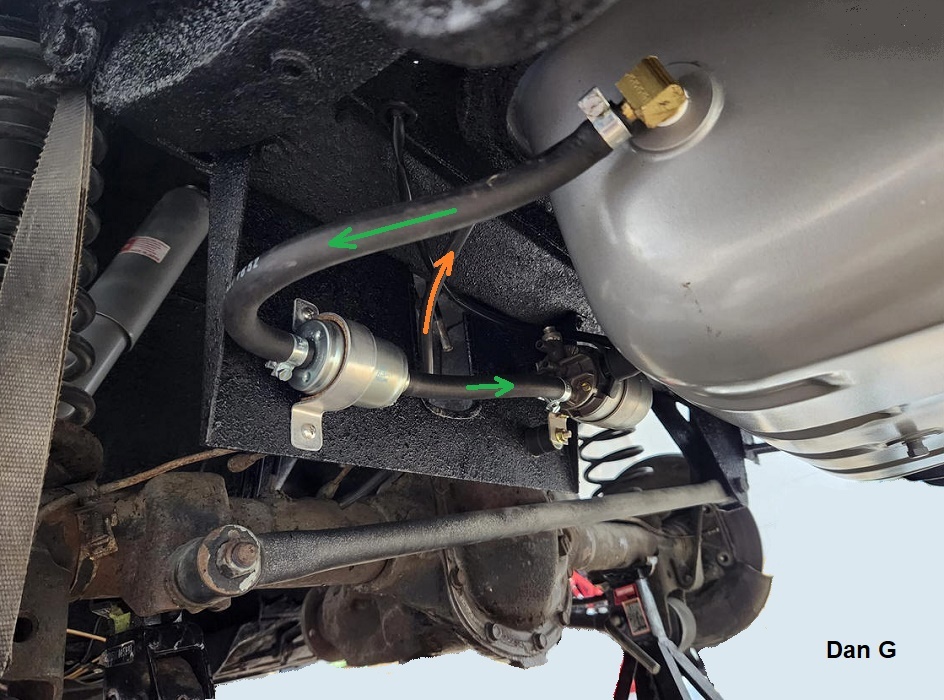
Fuel Tank Plumbing, 3 Port Fuel Pump (with Prefilter in replacement Tank):
Picture and description copied from: https://www.sw-em.com/Fuel_Tank_Notes.htm#1800E_Tank

Dan G provided this nice clean picture of his '71 1800E with a replacement
Tank*, showing the feed (Green)
to the (replacement) Three Port Pump from the side, FuPu outfllow
(Blue) to FuFi and beyond, and
the bypass outflow from Pump into "T" fitting
(Orn) , joining the Fuel Press
Reg Return from engine compartment (which is obscured).
* Notice that some replacement Tanks are configured with an internal Pre-Filter, so the external FuFi is plumbed post-pump...since there is no Pre-Filter in the original E Tank, the FuFi was located before Pump.
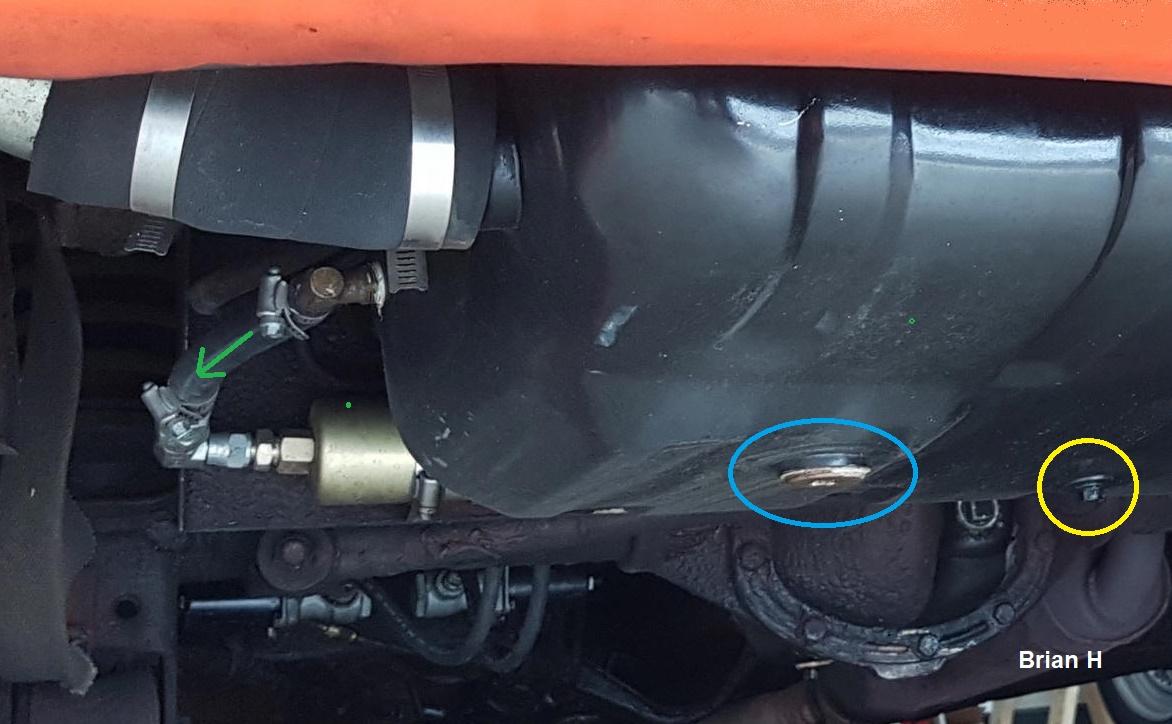
Brian H's ES Tank plumbing. Picture shown with his kind permission.
Yellow is Tank Drain. He
notes:
"When I replaced the tank, I noticed that the Strainer ("Pre-Filter" above the large brass Sumpplug) of the new VP Tank was partially melted(?!?) and was not sitting properly on the inlet pipe...so I decided to remove the plastic blob and try a Pre-filter. I found a large canister filter and fitted it with some fittings between tank and pump, it has worked fine for 9+ years. No effect on fuel pressure or drivability..." [That's OK when it's a new Tank and there is no debris coming from it to block the pre-filter and lead to fuel starvation as in the situation above. See: Correction for Noisy Fuel Pump with Pre-filter].
D-Jet Fuel Pump Overpressure Relief Valve Functional Test:
Posting to one of the
subfora:
"I just learned that the Fuel Pump, the one original to the '73ES, has an internal FP
relief valve, which I did not know. Is it possible that this relief valve is not
working, or would that show up as very high pressure at the FPReg?
My response to this posting: "Indeed, it would!" [...but the Overpressure Relief Valve only opens after some unusual condition has caused the pressure to rise to the valve's opening setpoint.]
Follow-up Question: Is there a way to test the system to verify that the FP relief valve is functional?
"It would be fairly simple to test function of
the Overpressure Relief Valve. Simply disconnect the input line to the Fuel
Pressure Reg, plug it (to run the FuPu "Deadhead" and with no flow to supply
engine) and apply power to the FuPu.
[See
Procedure below for details, after I thought about such a test some more!] I don't know to what precise pressure it
will rise [4.5kg/cm2 - 64PSI
see above!]...I expect it will be somewhere significantly above the normal
28-30PSI operating pressure, but the ORV should open and hold it to a
maximum of
around 60PSI as I recall (likely and I wouldn't be surprised if not with an
unusual sound signature which you probably have never before heard, as it
bypasses the FuPu output, since the fuel has "no place to go"!)
Safety and Cautionary Note: Since this test will subject parts of
the FI plumbing to pressures higher than usual, and you have reported leaks, be
especially observant for these, kill Ign Power immediately if they occur, and
observe open fuel precautions, with fire extinguishing equipment at the ready!
Please record and report observations, findings, and results. "
OBSERVE EXTREME CAUTION!: Performing a functional test of the Fuel Pump Overpressure Relief Valve, will require taking the pressure in the fuel delivery system, including Fuel Pump, Fuel Filter and any associated plumbing to pressures which they does not see in normal operation, and so may initiate fuel leaks in any connections subjected to those pressures. Be observant and ready for fuel leaks, including those at high pressure/squirting! Observe fire prevention practices and have extinguishing options at hand! Work Safely!
Fun the reader of the sw-em site may be used to, ends with fuel in the open, which is serious business! See also: LINK
Procedure:
1. Disconnect incoming fuel Hose from the Fuel Pressure Regulator and connect, by way of a high pressure capable connection and clamp, to a Pressure Gauge/Manometer rated for at least 80PSI (I have used an Oil Pressure Gauge for this).
2. Have a helper turn ON the Ignition with Key (only, it is necessary to crank Starter!), while you listen for the noise (bypassing) from the deadheaded FuPu, observe the pressure Gauge going to the bypass pressure, and are watchful for any leaks in the engine compartment AND also near the FuPu and Filter under the vehicle. Note: If necessary, it may be necessary to repeat turning ON Ign several times, since the FuPu will only run momentarily (for about 1 second), then time-out because engine is not running, and the time the system will hold pressure can vary greatly (it is likely to leak-down after some seconds, but this time is again highly variable).
3 The highest observed fuel pressure is the ORV relief pressure. Test Complete!
4. Restore normal fuel plumbing, checking for leaks (with Ign ON), before returning the car to normal service.
Rattling vs Cavitation Noises from a Fuel Pump in Distress:
Telling the difference between rattling and cavitation noises coming from a Fuel
Pump, both of which are probably new
and previously unfamiliar to the listener, is not the simplest thing to describe...sometimes
a video with soundtrack is better...!
Here is the author, diagnosing car noises from a description:

-------------------------------
External material sources are attributed. Otherwise, this article is Copyright © 2026. Ronald Kwas. The terms Volvo, Bosch, are used for reference only. I have no affiliation with either of these companies other than to keep their products working for me, help other enthusiasts do the same, and also present my highly opinionated results of the use of their products here. The information presented comes from my own experience and carefully considered opinion, and can be used (or not!), or ridiculed and laughed at, or worshipped, at the readers discretion. As with any recipe, your results may vary, and you are, and will always be, in charge of your own knuckles, and future!
You are welcome to use the information here in good health, and for your own non-commercial purposes, but if you reprint or otherwise republish this article, you must give credit to the author or link back to the SwEm site as the source. If you don’t, you’re just a lazy, scum sucking plagiarist, and the Boston Globe wants you! As always, if you can supply corrections, or additional objective information or experience, I will always consider it, and consider working it into the next revision of this article...along with likely the unique metaphor and probably (likely) wise-a** comment.
