A source of pilot stress in an aircraft...and only slightly less in a car!
Image Source: https://www.ainonline.com
"Smoke in the Cockpit!"
Nov 2021 R. Kwas (Comments Added)
------------------------------------------------
1800 (Lucas) Footswitch
Evaluation
122 (Bosch?) Footswitch Evaluation
I2R Heating in the VW World
Another Melted Plasdick Fuse!
Links
Fuse
your Cigarette Lighter!
Reference Information
IR Hotspot
Detected in London
------------------------------------------------
A source of pilot stress in an aircraft...and only slightly less in a car!
Image Source:
https://www.ainonline.com
Although a very rare occurrence aircraft, in cars, it has been known to occur with more frequency (particularly in Lucas equipped early 1800s!)...in either case, it does get ones full attention. At least we car-drivers can pull to the side of the road immediately to stop engine (Charging Sys is one power source), disconnect the Battery (the other power source), and investigate...or address flames!
With some good logical and systematic troubleshooting, mostly really just forensic analysis of the aftermath, all actually performed an ocean away, under the author's direction, this P1800 owner in the UK was able to locate and address the source of "Smoke in the Cockpit" (Yikes!). Link to thread: Dodgy Wiring, HELP "My P1800 started smoking from behind the steering wheel today". http://www.volvoforums.org.uk/showthread.php?t=89108
I would have liked to republish the pictures of the damage and associated troubleshooting recommendations, but unfortunately, it looks like some of the associated pictures are no longer at the link...I'll see if I can get them and include them here as it is an example of interpreting the forensic evidence, good troubleshooting technique with a successful outcome, which might help another P1800 owner.
Without having a picture of it, I do recall was the biggest hint...the Blue (18ga.?) wire between Light Switch and Foot Hi/Lo Beam Switch was severely overheated, that it was melted to the extent expected if it was passing current to a chassis short...it was obviously the source of the smoke. Since this power source wire, coming from the Lightswitch, was the only melted wire on the Footswitch, logical troubleshooting technique implies that the high current flowed to chassis AT the Footswitch, and indeed this had been the case.
Bottom line and cause of the smoke was two-fold: The Lucas Footswitch had been previously "repaired" or replaced, and poorly remounted, such that it was loose, and it also did not have an insulated bottom cover, which allowed one of the wire terminals (incoming power) to touch the chassis mounting surface...leading once again to the failure of a Lucas component being visible on IR Sat from space! See: Reference Information
I am in the process of disassembling and reviewing both 122 (Bosch(?) supplied) and 1800 (Lucas supplied) Footswitches, results of which will be published in a Tech Article...watch this space...!
Recapping the Thread:
"Cynic-al" wrote: "My P1800 started smoking from behind the steering wheel today..."
"Home now at least, courtesy of tow-truck, never thought I'd see the day!"

Electrically stricken 1800 needing rescue on a rainy British night...it looks
like the Marker Lights still work!
Unfortunately, this is the only picture
still present on the thread...hey, isn't he parked on the wrong side for the
UK...?
Excerpts of my postings to thread:
"Before reconnecting the battery, I'd
expend a good amount of effort to try to locate the source of the
smoke...including looking at back of dashboard with a good light source (and
possibly a mirror) and lightly probing around with an insulated poking
tool...also wiping with a cotton swab and sniffing it...once you've located the
melted wire or loose terminal, or area damaged by heat, report back with
findings. You can also trust the color code to tell you which circuit and load
device were involved. I also recommend squaring this issue away before taking
any significant drives.
Good Hunting!
PS. It's important when something like this occurs to gather as much associated
info...can you associate the smoke with having turned ON any particular
load...can you associate the smoke with a gauge (ie fuel, tach) or indicator
(Charging Indicator) working or not working or lit or not lit? Were headlights
ON at the time? Info like this is often invaluable in locating the problem."
He then posted a picture of the Footswitch (or Lightswitch) showing unmistakable evidence that the Blue wire what carried enough current to melt its insulation, making lots of acrid "Smoke in the Cockpit". Since it is the source of power to this wire, it can be deduced the Lightswitch must have been ON at the time of failure.
PLACEHOLDER for picture showing burned/melted insulation on Blue Wire at Footswitch and/or Lightswitch
Cynic-al Wrote: "...
I've taken the footswitch out. It seems to be lacking any form of backing that
would stop the connectors shorting against the body - this can't be right, can
it?
It seems that the blue wire must have shorted against the footwell, as the
switch was loosely attached and moving around. I am thinking if I can secure it
and put some insulation in that should sort the fault."
------------

1800 Wiring Diagram, marked-up in Orange to show fault current path. Since fault was
in the Lighting circuit which is considered mission critical and therefore is
not fused, a high fault current enough to superheat conductor of Blue Wire
(18ga), was
allowed to flow, resulting in melted insulation, and "Smoke in the Cockpit" .
--------------
As a reference, here is the underside of a used Lucas Footswitch procured once again from Chris Horn...no bottom insulator is present here either...it is also either lost, or the assembly never had one to begin with (I find this hard to believe!...if any reader has an 1800, known unchanged/unmolested since originally delivered, and can check this, I invite them to report their findings!), but without an insulator present, it is clear the terminals and their connectors would be "danger-close" to the mounting surface...a short circuit just looking to happen...and did, in Al's vehicle! Thankfully/luckily, the resulting damage was fairly limited and root-cause was also simple to address and make right.

Derek Scott of the British Volvo Owners Club and Forum, didn't like the absence of an insulated base very much either, so made one from fiber reinforced rubber...it fits perfectly, and keeps the electrical terminals of the switch safely separated and away from the conductive chassis mounting surface!
Derek Scott picture used with his kind permission.

Lucas Footswitch with an owner made insulator added...a very good modification
when not present!
If these were present when the switch was new must still be confirmed.
---------------------------------------------------
Not only vintage Volvo owners are plagued by I2R heating due to corroded connections! I expect this caused some "Smoke in the Cockpit" also.
Now that my son has a VW Westfalia camper, I've been also hanging around on VW
forums like thesamba.com, and VW T3 ( T25 ) Knowledge Exchange (a
 group), and it
seems like corroded connections are nothing unusual over there either...so I'm
trying to edumacate them about ACZP and convert them, one owner with corroded
electrics at a time...! Here is a good example:
group), and it
seems like corroded connections are nothing unusual over there either...so I'm
trying to edumacate them about ACZP and convert them, one owner with corroded
electrics at a time...! Here is a good example:
A picture from Thread "Ever seen a fuse melt like this?" on VW T3 ( T25 ) Knowledge Exchange
Wayne Arthur Dunford picture used with his kind permission.

chinashit strikes again!...as another example of cheapened replacement parts,
plasdick bodied fuses cannot stand the additional heat generated at the
fuse-ends, which occurs with poor connections...all fuses do generate a minor
and non-damaging amount of heat on their conductor as a normal mode of operation,
and this raises the conductor typically just a few degrees above the ambient (as
can be seen in IR scan below), but if more heat
is generated, due to a poor connection, this plasdick fuse body is not up to the
task, whereas a ceramic one would be! When using these chinatrash replacement fuses,
it would actually be advantageous to harvest the conductive current sensing
element from the plasdick bodied fuse, and replace it onto the ceramic body of a
(non-china) fuse. (Reference:
Mixing and Matching Fuse Conductors and Bodies ) Of course the best solution is to not allow a
poor connection to make excessive heat in the first place!
Note also that the conductive element is bent into a pretzel (I expect this mangling probably occurred during-less-than-gentle removal of the fuse, which had hot-melted itself into place semi-permanently), but the element itself actually exhibits no sign of having been (over)-heated, so this is definitely not the result of over-current generated heat!
My response: [Additional Comments]
"... When you pass current through a poor connection, it causes
(excessive) heat to be generated
(IR pic of an industrial fuse panel to make the point!), in this case, melting
the plastic fuse body (fuse conductor is in-tact meaning that this is NOT an
over-current situation! ...and melted
plastic of the fusebody is clearly concentrated at the fuse-end, where the poor
connections, and resulting heat-sources where located). Simple fix is to
bend spring side of the fuseholder to increase fuse holding preload...also
spinning replacement fuse to cut through any corrosion/contamination at the
circular contact area [...yes, I
recommended spinning the fuse(!), when normally I poopoo that move, but if
accompanied by application of ACZP to keep the now cleaned contact area in
perfect conducting condition (clean metal to clean metal under preload), it is
actually a good practice, because spinning the fuse while under spring preload
immediately cleans the contact area, and the encapsulation plus chemical
neutralization provided by the ACZP will keep it optimum for a loooong time.
Spinning the fuse ONLY, without further maintenance is a short-lived fix which
WILL fail again! See:
https://www.sw-em.com/anti_corrosive_paste.htm#Twist-the-Fuse-to-fix-it_Trick
]...but MOST important is to 1. Encapsulate the contact
area with Anti-Corrosive Zinc Grease, because this zinc-powder filled grease is
superior to the often recommended dielectric grease, because it 2. Galvanically
neutralizes any corrosion which starts under the encapsulation. See:
https://www.sw-em.com/anti_corrosive_paste.htm
Cheers from the vintage Volvo world, where our cars also have this style
Euro-fuses, and we also hate electrical corrosion, (and rust)!"

IR scan of an industrial power distribution panel showing the effect of normal
fuse heating (at body of the two outside fuses), and heating due to a poor connection at
the connection of the center fuse. Actually, the left fuse top connection
looks also to be making additional I2R heat, but clearly to a lesser extent than the
center fuse. Picture source: ?
---------------------------------------------------
Another Melted Plasdick Fuse!:
If it didn't already, I expect this condition was getting ready to cause some "smoke in the engine compartment"!
Core FB as received from Chris Horn (aka "Agent Strangelove") out there on the west coast:
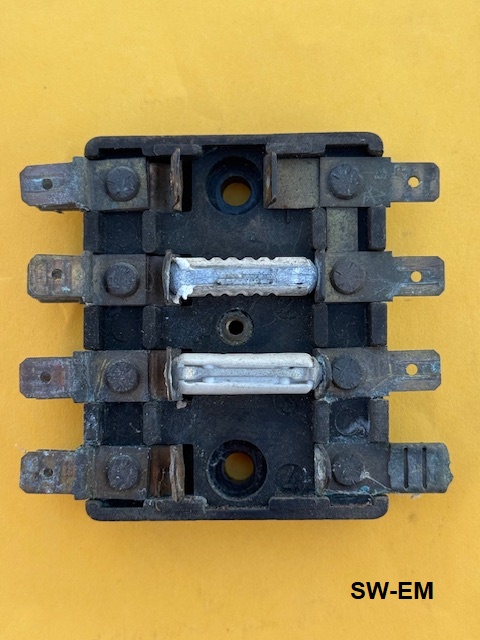
122 (also 12V 544) core fuseblock...whole and in corroded-only condition (so no
deduction on $15 core value. Reference:
Link), and suitable for SW-EM rework, (and making it be
BEST it can possibly be), but with an interesting finding upon closer
inspection!
Taking a cursory look at this specimen:
Fuses 1 and 4 are no longer in place, but Fuses 2 and 3 terminal surfaces exhibit LOTS of white corrosion products!
Body of the Fuse in position 2, is somehow distorted at the left... even shortened, lessening the contact force from the fuseclips! Indeed, its plasdick body at one end, has become heated and weak, which allowed the spring-compression of the holder, to compress and shorten it, loosing much of it's original conical end! Plasdick material has melted, and bubbled up around the fuse element conical end.
Fuse in position 3 is a ceramic bodied fuse, exhibiting no such deformation...its conical end is intact, supporting the matching conical end of the fusible element well, and because no shortening of the fuse has occurred, the contact force at both ends remains undiminished.

Let's remove both fuses and inspect the contact areas even closer!
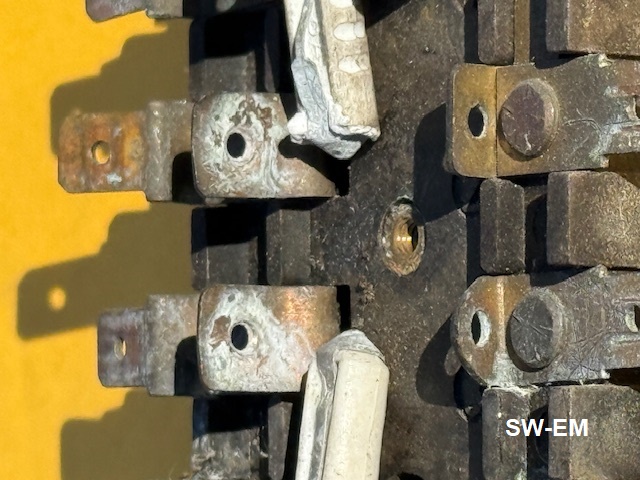
Plenty of white corrosion products are in evidence on both fuse and clip
surfaces. It's clear the upper (plasdick) bodied fuse has not stood up to the
additional heat generated due to the in-line Resistance to the circuit current
(heat even increases as the contact force decreases with the shortening of the fusebody). The lower (ceramic) bodied fuse is none-the-worse-for-wear as a
practical example of the hi-temperature superiority of the ceramic.
Electrically and functionally of course, the voltage-drop occurring in both circuits, resulted in downstream loads not getting their full Voltage and therefore not being able to perform their full allocation of work...weak, slow Wipers etc. for instance are the result!
PLACEHOLDER for practical Electrical Test where a test Current similar in magnitude to actual operating conditions, is routed through the two less-than-good connections, and temperature rise is observed and recorded (IR camera or IR pistol monitor).
Intermediate conclusions, which can be drawn, with explanations:
1. Exposure to under-hood conditions in combination with deferred maintenance, causes corrosion on Fuseblocks and their exposed surfaces! [ ...not much new or to explain there!]
2. Corrosion on contact surfaces, especially those actually in-line with the current carrying contact areas, will develop additional heat per the Ohms Law derivative equation P = R x I2 (where P is the power, in Watts generated; R is Resistance, in Ohms; and I2 is Current flowing through the Resistance; in Amps, squared), and since the Power is a function of the Current, squared, it can be seen from that equation, that the heat generated will go up very fast indeed (geometrically/exponentially!) with an increase in circuit Current.
Reference: I2R Heating
This unwanted heat is in addition to the associated Voltage Drops, which result in less power at the loads (do the words lightly glowing AMP Indicator and slow Wipers sound familiar?).
Notice and a reminder that the Fuse conductive element itself will actually also develop some heat as the natural and intended manner by which it functions, but the additional heat generated at the fuse-ends is unintended and unwanted, and can result in collateral damage, which in this can, it is well on the way to doing! Link: How does a fuse work?
3. Plasdick certainly has its place, but in this application, ceramic fusebodies are more tolerant of high temperatures when exposed to them...naturally, it's best if corrosion on terminals is prevented in the first place!
The factors of deferred maintenance, AND cheapo plasdick bodied replacement fuses, AND not using ACZP to protect connections have combined to evolve into a deteriorating situation where the next step would have been a meltdown of the fuse with smoke and possibly a subsequent electrical fire. Detract maximum points from the owner who let it come to this, for negligence!
Final conclusions, short versions:
1. Ceramic bodied fuses are always preferred!
2. Plasdick fusebodies suck (engineering term of emphasis!).
3. Using ACZP would have prevented most of what is shown and apparent here [but regular readers of the SW-EM site already knew that!].
---------------------------------------------------
1800 (Lucas) Footswitch Evaluation:
Lucas supplied Footswitch of the (early) 1800s [ not yet on-line...because although the SOB has been soaking in oil for about 6 months now, I STILL can't free up the button in order to cycle the mechanical action a few times before I open it up...but mark my words: I SHALL PREVAIL!]
---------------------------------------------------
122 (Bosch?) Footswitch Evaluation:
German made Footswitch of the 122s
---------------------------------------------------
Links to other occurrences of "Smoke in the Cockpit", and their cause and resolution:
In this case, the Cigarette Lighter of a 122 failed in use, and since it is also not fused and the smallest gauge wire in the current path to chassis, my recommendation: Fuse your Cigarette Lighter!
How about some "Smoke under the Hood"?
---------------------------------------------------
Chris Horn, keeper of organ donor Amazons and one of my favorite sources of used components: agent_strangeloveAThotmailDOTcom>
------
I've noted before about the manner with which Lucas automotive components (aberrations!) tend to fail...now, we have this:

A scan from the Advanced Spaceborne Thermal Emission and Reflection
Radiometer (ASTER) on NASA’s Terra satellite
...of London on the night of Al's
HI/LOBeam switch "Smoke in the Cockpit" incident ...!
Image source:
https://earthobservatory.nasa.gov/images/3200/london-england
---------------------------------------------------
External sources attributed when possible. Otherwise this information is Copyright © 2022-2026 Ronald Kwas. The terms Volvo, Bosch, and Lucas are used for reference only. I have no affiliation with the former two, other than to try to keep their fine vintage products working for me, and to help other enthusiasts to do the same, and to give the later all the grief they have earned and deserve! (See: Proving Everything Bad you Ever Heard About Lucas ) The results and information presented here are my own experience, and highly opinionated impressions, and can be used or ridiculed and laughed at, or worshipped, as you see fit. As with any recipe, your results may vary, and you are, and will always be, in charge of your own knuckles, and future!
You are welcome to use the information here in good health, and for your own non-commercial purposes, but if you reprint or otherwise republish this article, you must give credit to the author or link back to the SwEm site as the source. If you don’t, you’re just a lazy, scum sucking plagiarist, and the Boston Globe wants you! As always, if you can supply corrections, or additional objective information or experience, I will always consider it, and consider working it into the next revision of this article...along with likely the odd metaphor, or analogy (see: ABS!) and probably wise-a** comment.